
Property Conveyancing Explained: From Sale Agreed to Closing
For many buyers, the period between hearing the words "Sale Agreed" and collecting the keys to their new home can feel like a mystery. Questions arise about contracts, legal enquiries, title documents, delays and why weeks can pass without much visible progress.
The reality is that this is often the busiest stage of the transaction, and the one where most patience is needed.
Conveyancing is the legal process of transferring ownership of a property from the seller to the buyer. While the estate agent negotiates the sale, it is the solicitors who carry out the detailed legal work to ensure the property can be transferred safely and that the buyer receives a good clear title.
Understanding what happens behind the scenes can make the process feel far less daunting and help set realistic expectations from the outset.

What Does “Sale Agreed” Mean?
When a property is marked Sale Agreed, the buyer and seller have agreed on the purchase price and basic terms of the sale.
However, many buyers are surprised to learn that the sale is not yet legally binding.
At this stage:
The buyer can still withdraw.
The seller can still accept another offer.
Contracts have not yet been signed or exchanged.
The legal conveyancing process now begins.
The conveyancing process typically takes around 8–12 weeks from Sale Agreed to Closing, although every transaction is unique. Some purchases may complete more quickly, while others can take considerably longer depending on a range of factors. Common causes of delays include the complexity of the legal title, the time taken to prepare and review the contract package, responses to pre-contract enquiries, obtaining management company information for apartments, mortgage approval and loan drawdown, planning or boundary issues, probate, and whether the transaction forms part of a property chain. While waiting can sometimes feel frustrating, much of this time is spent carrying out the legal investigations and due diligence needed to ensure you receive a clear title to the property.
Stage 1: Solicitors Are Instructed & the Contract Package is Prepared
Typical timeframe: Usually within the first 2–4 weeks after the property goes Sale Agreed.
Once a property goes Sale Agreed, both the buyer and seller appoint their solicitors. The seller's solicitor's first priority is to prepare the Contract Package, while the buyer's solicitor opens the legal file and prepares to begin the legal investigation. Although there may be little visible activity during this stage, a significant amount of work is taking place behind the scenes.
The Seller's Solicitor
The seller's solicitor assembles the Contract Package, which will later be issued to the buyer's solicitor. This typically includes:
Draft Contract for Sale
Land Registry title documents
Property maps and folios
Planning permissions and Certificates of Compliance (where available)
BER Certificate
Local Property Tax information
Details of any existing mortgage that will be discharged on closing
Management company information (where applicable)
The seller's solicitor will also gather information directly from the seller about the property, including:
Occupancy details
Alterations or extensions
Rights of way
Boundary issues
Notices received from local authorities
Neighbour disputes or other matters affecting the property
Using this information, the seller's solicitor prepares the Replies to Standard Pre-Contract Enquiries. These are the seller's responses to a standard set of legal questions about the property and form an important part of the Contract Package.
The Buyer's Solicitor
During the same period, the buyer's solicitor will:
Open the legal file.
Verify the buyer's identity.
Complete Anti-Money Laundering (AML) requirements.
Verify proof and source of funds.
Request the Contract Package from the seller's solicitor.
Communication You Should Expect
Your solicitor will usually confirm they have been instructed and let you know that the Contract Package has been requested from the seller's solicitor.
Stage 2: Reviewing the Contract Package & Raising Contract Queries
Typical timeframe: This stage usually takes place during the first 4–8 weeks after a property goes Sale Agreed, although more complex transactions—particularly apartment purchases—may take longer.
Once the Contract Package has been received, the buyer's solicitor begins a detailed legal investigation. Their role is to ensure you're buying exactly what you believe you are buying, that the seller has the legal right to sell it, and that there are no legal issues that could affect your ownership or future resale.
As part of this review, your solicitor will examine:
Ownership and Land Registry records
Property boundaries and maps
Rights of way and easements
Restrictive covenants
Existing mortgages or legal charges
Planning permissions and Certificates of Compliance
Replies to Standard Pre-Contract Enquiries
Other documents affecting the property's legal title
The Replies to Standard Pre-Contract Enquiries provide important information that isn't always evident from the title documents, including:
Who currently occupies the property.
Whether vacant possession will be provided on closing.
Any extensions or alterations.
Rights of way or boundary issues.
Notices received from the local authority.
Neighbour disputes or other known issues affecting the property.
Your solicitor compares these replies against the supporting legal documents and, where necessary, requests further clarification or evidence.
Apartment Purchases
If you're buying an apartment or another property within a managed development, your solicitor must also review the management company information pack, commonly known as the MUD Act replies (documents provided under the Multi-Unit Developments Act 2011).
This typically includes information about:
Service charges and sinking fund
Building insurance
AGM minutes
Planned major works or special levies
Fire safety
Management company accounts
Confirmation that service charges have been paid
Any disputes or litigation affecting the development
Because much of this information must be prepared specifically for each sale, it typically takes 2–6 weeks to obtain and is one of the main reasons apartment purchases often take longer than house purchases.
Contract Queries
Once the legal review is complete, the buyer's solicitor will usually raise a series of follow-up legal enquiries, known as Contract Queries. This is a completely normal part of the conveyancing process, and almost every property transaction involves them.
Contract Queries seek clarification on issues identified during the legal investigation or request additional documents before the buyer is advised to proceed.
Typical queries may relate to:
Missing planning documents or Certificates of Compliance
Boundary or access issues
Rights of way
Management company information
Outstanding service charges
Clarification of information provided by the seller
The seller's solicitor will obtain replies from the seller and, where necessary, architects, engineers, managing agents, local authorities or other third parties. It is common for several rounds of enquiries and replies to take place before the buyer's solicitor is satisfied that all significant legal issues have been resolved.
Communication You Should Expect
During this stage, updates may be less frequent while your solicitor reviews the documents and awaits replies to legal enquiries. Typical updates might include:
"We've received the Contract Package and are reviewing the legal title and supporting documentation."
"We've now raised our Contract Queries and are awaiting replies from the seller's solicitor."
This stage often takes the longest because your solicitor is relying on information from the seller and various third parties. Although there may be periods of little visible activity, much of the legal due diligence that protects your interests takes place during this time.

Stage 3: Signing and Exchanging Contracts
Typical timeframe: Once all legal enquiries have been satisfactorily answered. This stage is typically reached within 8 weeks after going Sale Agreed for a straightforward cash purchase, although more complex transactions may take longer.
Once the buyer's solicitor is satisfied that they have completed their legal investigation and all significant enquiries have been answered, they will advise the buyer that it is appropriate to sign the Contract for Sale.
Before recommending that you sign, your solicitor should explain any remaining legal matters, answer any outstanding questions, and confirm that they are satisfied you will receive good and marketable title to the property.
The seller will also sign their copy of the contract.
Although both parties may have signed the contracts, the sale does not become legally binding until:
The agreed contract deposit has been received by the seller's solicitor.
The signed contracts are formally exchanged between the solicitors.
Once contracts have been exchanged:
The buyer is legally committed to complete the purchase.
The seller is legally committed to complete the sale.
The agreed closing (completion) date is confirmed.
Neither party can withdraw from the transaction without potentially significant legal and financial consequences.
This is one of the most significant milestones in the conveyancing process, as the transaction moves from an agreement in principle to a legally binding contract.
Communication You Should Expect
Your solicitor will typically contact you to:
Confirm that all legal enquiries have been satisfactorily resolved.
Explain any remaining legal matters.
Advise that it is appropriate to sign the contracts.
Confirm when contracts have been exchanged.
Advise that the transaction is now legally binding.
Confirm the agreed closing date and explain the next steps leading up to completion.
Stage 4: Preparing for Closing
Typical timeframe: Usually 1–3 weeks after contracts have been exchanged, although this can vary depending on the agreed completion date.
Once contracts have been signed and successfully exchanged, the sale is legally binding and both solicitors begin preparing for the transfer of ownership on the agreed closing date.
The Buyer's Solicitor
During this stage, the buyer's solicitor completes several important legal and financial tasks to ensure everything is ready for completion.
This typically includes:
Carrying out final legal searches to confirm that nothing has changed since contracts were exchanged, such as new mortgages, judgments or legal charges being registered against the property.
Preparing the Completion Statement, which provides a detailed breakdown of the funds required to complete the purchase. This usually includes the remaining purchase price, Stamp Duty, legal fees, VAT, registration fees and any other outlays.
Requesting the balance of the purchase funds from the buyer and confirming when these funds need to be received.
Preparing the completion documentation required to complete the purchase.
Confirming the closing arrangements with the seller's solicitor.
The Seller's Solicitor
At the same time, the seller's solicitor is also preparing for completion by:
Obtaining the final mortgage redemption figures (if there is an existing mortgage).
Preparing the transfer documents that will be handed over on closing.
Confirming that all documentation required for completion is in order.
Agreeing the practical arrangements for completion with the buyer's solicitor.
Final Inspection
Many buyers choose to carry out a final inspection of the property shortly before closing.
This provides an opportunity to confirm that:
The property remains in substantially the same condition as when contracts were exchanged.
Any agreed repairs have been completed.
Fixtures and fittings included in the sale remain in place.
The property will be provided with vacant possession, unless otherwise agreed.
Although this inspection is not a legal requirement, it can provide valuable peace of mind before the purchase is completed.
Communication You Should Expect
As closing approaches, your solicitor will usually contact you to:
Provide your Completion Statement showing the balance required to complete the purchase.
Advise when your remaining funds should be transferred.
Confirm that all legal preparations are progressing as expected.
This is generally one of the more active stages of the transaction, with regular communication between the buyer, seller, both solicitors and the estate agent to ensure everything is in place for a smooth completion.
Stage 5: Closing Day
On the agreed closing (completion) date, the buyer's solicitor transfers the balance of the purchase funds to the seller's solicitor. Once the funds have been received and all completion documents are in order, the seller's solicitor authorises the estate agent to release the keys to the buyer.
The buyer can then take possession of the property and officially becomes the new owner.
Although many buyers receive their keys on the day of closing, it's important to understand that the release of funds, confirmation between solicitors and key collection all take place during normal business hours. If funds are received late in the day, or there are banking or administrative delays, the keys may not be released until the following business day.
For this reason, it's generally advisable to avoid booking removal companies, ending temporary accommodation or making other time-critical arrangements for the day of closing. Waiting until you have confirmation that the funds have been received and the keys are available can help avoid unnecessary stress.
Communication You Should Expect
On closing day, your solicitor will usually keep you updated by confirming:
That the purchase funds have been transferred.
When the seller's solicitor confirms receipt of the funds.
When the transaction has completed.
When the estate agent has been authorised to release the keys and where they can be collected.
Stage 6: Registration
Although you've collected the keys, your solicitor still has important work to complete.
This includes:
Paying Stamp Duty.
Registering you as the new owner with the Land Registry.
Completing any post-closing documentation.
Arranging your title deeds following registration.
Registration can take several months, but your ownership is protected from the date of completion.

Why Does Conveyancing Take Time?
One of the biggest misconceptions about conveyancing is that delays are usually caused by solicitors. In reality, much of the process depends on information from sellers and third parties before your solicitor can safely advise you to proceed.
Common reasons for delays include:
Preparing the Contract Package and gathering the necessary title documents.
Contract Queries, which often require replies from the seller, architects, engineers or other professionals.
Planning documentation, particularly where extensions, attic conversions or other alterations require supporting certificates or approvals.
Management company information for apartments. The Owners' Management Company (OMC) or its managing agent must prepare a management information pack (commonly known as the MUD Act replies), which often takes 2–6 weeks to produce.
Third-party responses from organisations such as managing agents, banks, engineers, architects, local authorities and the Land Registry, all of which work to their own timelines.
It's also important to remember that periods of silence don't necessarily mean nothing is happening. Behind the scenes, your solicitor may be reviewing legal documents, chasing outstanding information, assessing replies to Contract Queries, speaking with third parties, and resolving issues before recommending that you sign contracts.
While waiting can sometimes feel frustrating, every stage of the conveyancing process is designed to protect your investment. A successful transaction isn't measured by how quickly contracts are signed, but by how thoroughly your solicitor investigates the property before you become legally committed.
Understanding what happens behind the scenes—and why delays sometimes occur—can make the journey from Sale Agreed to Closing far less stressful and help you move into your new home with confidence.
How a Buyer's Agent Can Help During Conveyancing
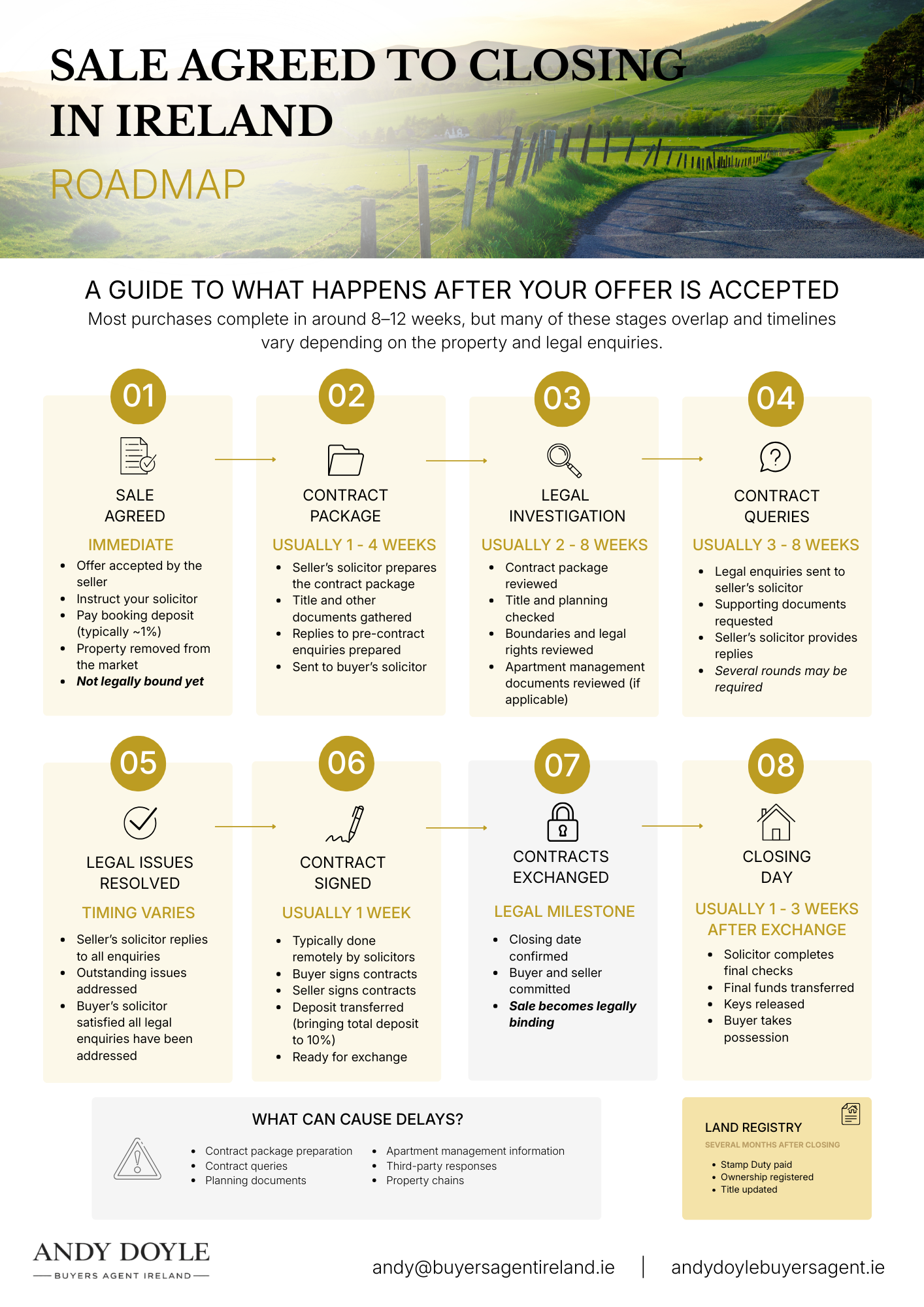
Sale Agreed to Closing in Ireland Roadmap
While your solicitor is responsible for the legal conveyancing process, a buyer's agent can help guide you through what is often the most uncertain stage of buying a home.
Every buyer's agent has their own way of working, but our approach is built around three key principles:
Educating You Early
We believe many of the frustrations buyers experience come from not knowing what to expect. From the outset, we explain each stage of the conveyancing process, the role of the different professionals involved, typical timelines, and the most common reasons transactions slow down. Having realistic expectations can make the process far less stressful.
Keeping Communication Open
Conveyancing often involves periods where there is little visible progress. Rather than leaving you wondering what's happening, we maintain regular communication with you and keep in touch with the estate agent, solicitor, mortgage broker, surveyor and other professionals involved, helping you understand where the transaction stands and what the current priorities are.
Helping Keep the Process Moving
While a buyer's agent cannot provide legal advice or influence the solicitor's legal investigation, we can help keep the transaction moving by following up with the appropriate parties when needed, ensuring information is flowing between everyone involved, and helping identify where the current bottleneck lies. Our role is to help coordinate the process, answer questions, and provide clarity so you always understand what happens next.
Ultimately, our goal is not simply to help you buy a property—it's to help you navigate the journey with confidence, knowing that someone is there to explain the process, coordinate communication, and advocate for your interests from Sale Agreed through to collecting the keys.
Check out the full timeline of purchasing a property in Ireland: How Long Does It Really Take to Buy a House in Ireland? Timeline Explained
Thinking About Buying Property in Ireland?
Whether you're relocating from the United States, returning home after living abroad, or simply exploring the Irish property market, I'm always happy to help.
If you'd like independent guidance or would like to learn more about how a buyer's agent can support your purchase, feel free to get in touch.
Even if you decide you don't need representation, I'd much rather you begin your property search informed, prepared and confident.